Measuring at home
Which way should a blood pressure cuff face?
A quick guide to checking the artery marker and tube direction on an upper-arm blood pressure cuff.
I thought I was using my blood pressure monitor correctly. The cuff felt secure and the machine produced a reading, so nothing seemed wrong.
Then my doctor asked me to demonstrate. The cuff was turned the wrong way and its tube was pointing up my arm instead of down towards my hand.
Which way should the cuff face?
Start with the instructions supplied with your monitor because cuffs are not all designed in exactly the same way.
On many conventional upper-arm cuffs, the artery marker sits over the inside of the arm and the tube runs down towards the hand. Some wraparound cuffs are designed differently, so the markings and diagram for your cuff take priority.
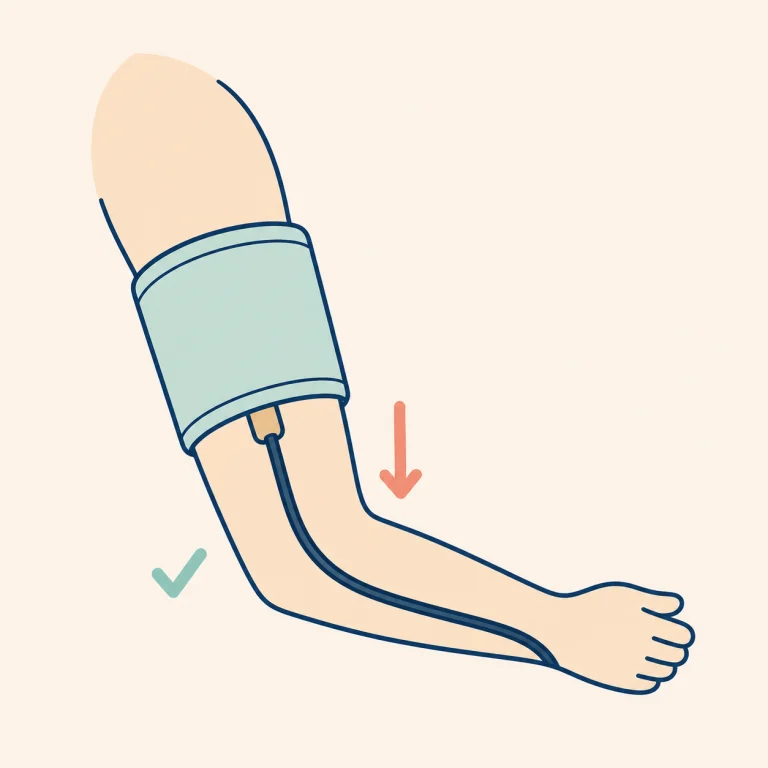
Follow your cuff's marker and instructions. On many upper-arm cuffs, the tube runs down the inside of the arm.
Before pressing Start, check that:
- the cuff is on bare skin and is the correct size;
- its lower edge is positioned as shown in the instructions;
- the artery marker and tube follow the cuff's diagram; and
- your arm is supported with the middle of the cuff at heart level.
For the full routine, see How to measure and record blood pressure at home.
Does an upside-down cuff make the reading wrong?
Not necessarily, and you cannot tell from the displayed numbers alone.
The effect depends on the cuff's design and fit. Some wide-range cuffs are less sensitive to their position around the arm, while others are intended to be aligned in a particular way.
If you discover a mistake, follow the correct technique from then on and note what changed. Do not reinterpret old readings or change medication on your own.
Take your monitor to an appointment and demonstrate exactly how you use it. A healthcare professional can check its size, placement and results against the equipment used in the clinic.
BpBook keeps readings and notes together, so you can record when you corrected your cuff placement and share the surrounding pattern at an appointment.
Start your BpBookWhen to ask for help
Ask a healthcare professional or pharmacist if the cuff does not fit, you cannot identify its markings or you are unsure about your technique.
Do not change prescribed medication based on this article or a single home reading. If you feel seriously unwell or believe you may be experiencing a medical emergency, seek urgent medical help through your local emergency service.
Sources
- American Heart Association: Home Blood Pressure Monitoring
- American Heart Association and American Medical Association: How to Measure Your Blood Pressure at Home
- Omron: Applying an upper-arm cuff
- Palatini and colleagues: Impact of cuff positioning on blood pressure measurement accuracy
Sources last checked 7 August 2026.