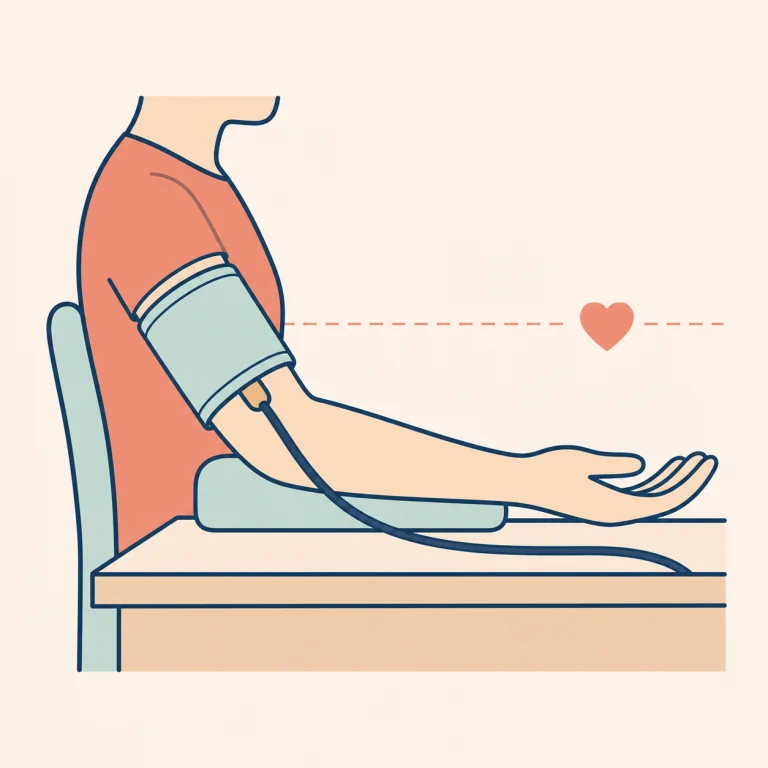
For home use, the American Heart Association recommends a validated automatic upper-arm blood pressure monitor. If an upper-arm cuff is unsuitable, discuss alternatives with a healthcare professional and check the exact wrist model’s validation, fit and positioning instructions. A wrist cuff and a cuffless smartwatch are different devices.
Compare the complete setup
| Check | Upper arm | Wrist |
|---|---|---|
| Fit | Arm circumference within the supported cuff range | Wrist circumference within the device's range |
| Position | Cuff and supported arm positioned as instructed | Wrist position, heart level and limited movement as instructed |
| Evidence | Exact model, population and cuff information | Exact wrist model and its intended users |
| Practical check | Can you fit it and repeat the setup? | Can you hold the required position consistently? |
A cuff at the wrist is also a different device from a cuffless smartwatch. One uses an inflatable cuff at a different site; the other may provide an estimate or notification through a separate feature. Do not transfer evidence between them because both are worn near the wrist.
When an upper-arm cuff is difficult to use
Explain the actual problem to a clinician or pharmacist: a cuff outside the appropriate size range, difficulty applying it, or a positioning requirement you cannot manage. Ask them to assess the options and demonstrate the method you would use at home.
ValidateBP describes validated wrist devices as possible alternatives in specific circumstances. That does not mean every wrist monitor is an appropriate replacement, or that the usual upper-arm recommendation has disappeared.
Use the validation lookup guide for a model check. If you already own an upper-arm monitor, confirm its available compatible cuffs before assuming that a wrist device is the only option. The cuff-size guide explains how to compare your measurement with the stated range.
Avoid turning a home comparison into an accuracy verdict
Two devices can give different numbers during separate attempts. One side-by-side pair does not establish which device is accurate or provide a correction to apply to future results.
Bring the device and its instructions to an appointment. Show how you position it, and ask which equipment and routine to use for your continuing record.
Record which device produced the result
Keep its model and measurement site with your notes. When equipment changes, mark the date instead of silently combining records as if the conditions were identical.
The blood pressure log gives you a place to record readings and context. A logging tool cannot correct a measurement made with unsuitable equipment or technique.
Frequently asked questions
Is a wrist cuff the same as a smartwatch feature?
No. A wrist cuff uses an inflatable cuff. A cuffless watch feature has its own intended use and evidence; do not transfer validation between them.
Can I apply an offset between two monitors?
A pair of different readings does not establish a correction factor. Preserve the originals and ask a healthcare professional to compare equipment and technique.
Sources
- American Heart Association: choosing and using a home monitor
- ValidateBP: device directory and wrist-device guidance
- STRIDE BP: monitor directory
Sources reviewed 20 October 2026. Follow the equipment advice and monitoring plan given for your own situation.